
Sciatica · Olathe, Kansas
Nonsurgical Treatment for Sciatica
Leg pain that starts in your back has a cause. Find out what yours is.
Sciatica is a symptom, not a diagnosis. The evaluation identifies what is compressing the nerve and whether nonsurgical treatment is appropriate for it.
- For sciatica that has not resolved with rest, medication or therapy
- Nonsurgical, seated treatment — no injections
- You find out whether you are a candidate at the first visit
- Your first visit is free, and includes your first treatment
Or call or text (913) 355-5998
- Dr. Matt Metcalf, DC
- 20+ years
- 65,000+ treatment visits supervised
- 5.0 on Google
Sound familiar?
Does this sound like your sciatica?
Sitting is usually the hardest part: a car seat, a desk chair, a restaurant booth. Sleep is broken by the search for a position that does not light the leg up. Standing to work, standing to eat and pacing during phone calls become normal.
- Pain that shoots from your back or buttock down one leg
- Sitting makes it worse; you stand at your desk or pace on calls
- Numbness or tingling in the leg or foot
- You have tried stretches, medication or an injection
- Nights are broken by the search for a position that works
Common symptoms of sciatica
- Pain that starts in the low back or buttock and travels down one leg, sometimes to the foot
- Burning, electric or shooting pain rather than a dull ache
- Numbness, tingling or pins and needles in the leg or foot
- Weakness — a foot that drags, a knee that gives, difficulty rising onto your toes
- Worse with sitting, coughing or sneezing; often easier walking
If two or more of these are true, a free first visit is the logical next step. It is the only way to know what is contributing to your symptoms and whether nonsurgical treatment is appropriate.
What sciatica is
What sciatica is, and why it keeps coming back
The sciatic nerve is formed by nerve roots that leave the lower spine, pass through the pelvis and run down the back of each leg. When one of those roots is compressed or inflamed — most often by a herniated or bulging disc, sometimes by a narrowed canal — the pain is felt along the nerve's path, not at the spot where the problem is. That is why the leg can hurt more than the back.
Between each pair of vertebrae sits a disc. When it's healthy, it's tall and full of fluid, and it holds open the space where a nerve leaves your spine.
Years of sitting, lifting and gravity compress it. It loses water and height, that space narrows, and the nerve gets crowded. That's what sends pain, numbness and tingling down a leg or an arm.
It doesn't fix itself, because discs have no blood supply. They depend on pressure changing as you move — and a compressed disc isn't getting that.
How spinal decompression treats it
Non-surgical spinal decompression gently separates the vertebrae, taking pressure off the disc and giving the nerve room. Repeated over a course of care, that's what gives symptoms a chance to settle.
Sciatica treatment options
Most of the usual approaches manage the symptom. Fewer address the load on the disc.
None of these are wrong, and some of them may be part of your care. The question the evaluation answers is whether something is still loading the disc or the nerve — and whether that is something we can change.
Nonsurgical treatment options for sciatica
- Staying active with a specific movement plan rather than bed rest
- Physical therapy, including nerve mobilization and trunk control
- Medication or an epidural steroid injection, prescribed by a physician
- Non-surgical spinal decompression when a disc is compressing the root — gently separating the vertebrae to give the nerve room
- Surgical consultation for progressive weakness or symptoms that have not improved with a proper nonsurgical course
| Usual approach | What it does |
|---|---|
| Rest and ice | Reduces inflammation for a while. Does not change what is loading the disc. |
| Pain medication | Blocks the pain signal. Useful; does not address the source. |
| Injections | Reduces inflammation around the nerve, often temporarily. |
| Physical therapy | Strengthens the muscles that support the spine — valuable, and sometimes not enough on its own when a disc is the driver. |
| Surgery | Removes or fuses tissue. Sometimes necessary. A large step to take before nonsurgical options have been properly evaluated. |
Our approach
Evaluate first. Then treat, measure and adapt.
We focus on nonsurgical treatment for appropriate spine, disc and nerve conditions. Treatment begins with an evaluation so we can determine whether our approach is appropriate for your condition.
- 01
Evaluate
Determine what may be contributing to your symptoms.
- 02
Treat
Begin appropriate nonsurgical treatment if you are a candidate.
- 03
Measure
Track your response to treatment.
- 04
Adapt
Change the plan based on how you respond.
Why evaluation matters for sciatica
Leg pain can come from a disc pressing on a nerve root, from a narrowed spinal canal, from the sacroiliac joint, from the hip, or from muscles in the buttock irritating the nerve. Those look similar from the outside and respond to different treatment. Examination — where the pain is, what reproduces it, which nerve is involved — tells them apart.
How we evaluate sciatica
Your evaluation includes a history of when the leg pain started and what changes it, a neurological examination of the leg (strength, reflexes and sensation), specific tests that tension the nerve, and a review of your imaging if you have any. If the pattern points to a compressed nerve root that our approach is suited to, we say so and explain how we would treat it and track it. If it points elsewhere, we tell you where.
When additional medical evaluation is necessary. Sciatica with numbness in the groin or inner thighs, difficulty starting or controlling urination, or weakness that is getting worse day to day is a medical emergency. Go to an emergency department. Do not wait for an appointment here.
What a spinal decompression visit is like
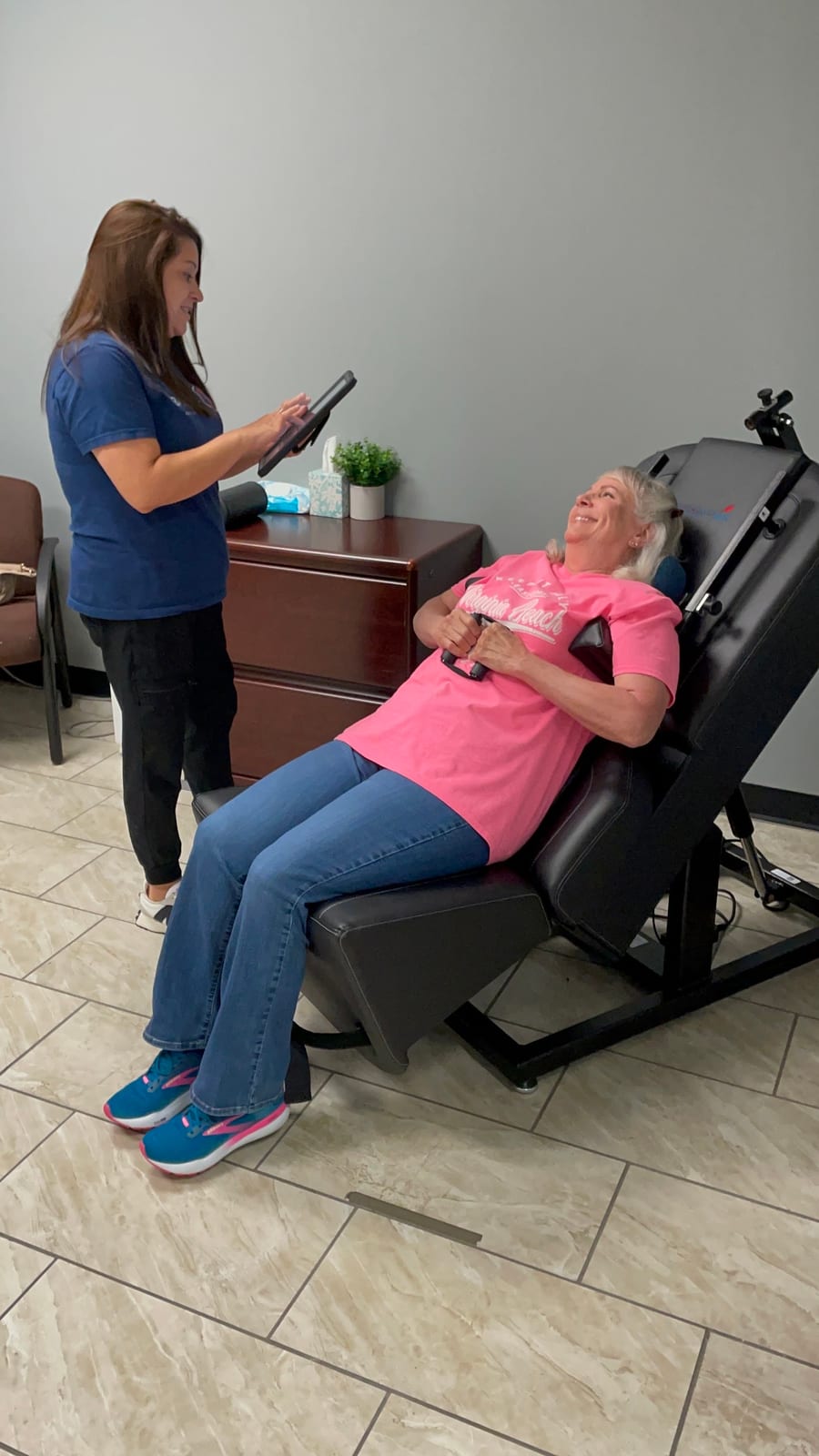
Non-surgical, with no injections and no incisions. You are seated and reclined, not face-down and not in a harness. Treatment can be directed at the low back or the neck, the settings are set for you, and each visit is built around you. Whether it is appropriate for you is decided at your first visit.
Honest about who it's for
It is not for everyone, and no one can promise you an outcome before examining you. For the right patient it takes the load off a painful disc without surgery, and we measure your response rather than assume it. The free first visit is how we find out whether you are that patient.
Honest about fit
Who this is for, and who it isn't for
Spinal decompression is not for everyone, and we would rather tell you that before you come in.
It is often right for
- Bulging or herniated discs in the lower back
- Cervical disc herniation
- Sciatica, or pain that runs down a leg
- Neck pain that travels into the shoulder, arm or hand
- Numbness or tingling in the hands or feet
- Grip weakness
- Headaches from neck tension
- Pinched nerves
- Degenerative disc disease
- Spinal stenosis with positional leg symptoms
- Facet pain
- Pain after back or neck surgery, including a fusion once the recovery period has passed
- Pain that hasn't responded to the usual care
It is usually not right for
- Spinal fractures
- Severe osteoporosis
- Tumors or infection
- Spinal instability or cord-level symptoms
- Some conditions we screen for at your first visit
The first visit is where we find out which list you're on. If you've had a fusion or have hardware, we check how long ago and clear it with you at the first visit.
The first step
Start with a free first visit.
Free
Your first visit at Back-Trac Spinal Decompression is free. It includes a one-on-one consultation with Dr. Metcalf, a review of your MRI or X-rays if you have them, an exam, and your first spinal decompression treatment the same day. You'll leave knowing whether you're a candidate.
Schedule my free consultationWe text you within a minute to set your free first visit, any hour. If you don't check the text box, we call you back.
What your free first visit includes
- A one-on-one consultation with Dr. Metcalf
- A review of your MRI or X-rays, if you have them
- An exam, with a measured baseline
- Your first spinal decompression treatment, the same day
- A straight answer on whether you're a candidate
- If you are, a plan for what comes next
No obligation. New patients only. Some insurance plans are excluded by law.
What you'll learn
What you walk out knowing
1What is actually contributing to your symptoms
Not a guess from a report: findings from an exam, read alongside your imaging.
2Whether you are a candidate
A straight answer at the first visit. If you are not, we tell you and point you to the right care.
3How your body responds
Your first spinal decompression treatment happens the same day, and we record your response.
4What comes next
If you are a candidate, a plan, before you decide anything.
Patient reviews
From patients who came in with the same thing.
Every review is a verified Google review of this clinic, quoted as written.
“Sciatica had me shifting around constantly, especially sitting for any length of time. … the leg pain's way down and I can actually sit through a meeting or a movie without needing to move.”
Aaron B.Verified Google review
“Foot pain from sciatica used to flare up bad just from standing too long. … that pain's way down now — I can stand and walk around without it acting up, which was the whole reason I came in for the herniated disc.”
Clairelle W.Verified Google review
“Sciatica and back pain had me pretty miserable, but it's so much better now.”
Michael P.Verified Google review
FAQ
Questions about sciatica
Do you treat sciatica?
What happens at my free first visit?
Is the first visit really free?
What happens after the free visit?
Will insurance cover this?
How do I set my first visit?
How does spinal decompression work?
Free first visit · New patients only
Schedule your free consultation and treatment
Your first visit is free: sit down with Dr. Metcalf, go over your MRI or X-rays, get your questions answered, and start spinal decompression treatment the same day.
Dr. Matt Metcalf, D.C.
1011 E 151st St
Olathe, KS 66062
By appointment
Your free first visit includes:
- A one-on-one consultation with Dr. Metcalf
- A review of your imaging
- An exam
- Your first treatment, the same day
Prefer to talk? Call or text (913) 355-5998.
Related conditions

Find out whether we can help with your sciatica.
Back-Trac Spinal Decompression · 1011 E 151st St, Olathe, KS
Or call or text (913) 355-5998